



Cloud Infrastructure Services
Build a Secure, Scalable Cloud Infrastructure
Build reliable cloud environments around your workloads, security requirements, growth plans, and operational priorities with expert architecture, engineering, migration, and management support.
- Cloud Architecture & Engineering Expertise
- AWS, Azure & Google Cloud
- Security-First Infrastructure Design
- Automated Provisioning & Deployment
- End-to-End Cloud Management
Our Technology Partners
Built on Trusted Technology Platforms
We work across leading cloud, CRM, and AI platforms, so every recommendation is based on what fits your business, not a single vendor.







The Business Need
Why Businesses Need Cloud Infrastructure Services
Cloud environments can become expensive, difficult to scale, and harder to govern when infrastructure decisions are disconnected from workload and business requirements.
Rising Cloud Infrastructure Costs
Poorly sized compute, idle environments, inefficient storage, and unmanaged consumption can raise cloud operating costs without creating proportional business value.
Performance and Scalability Limitations
Infrastructure that cannot adapt to changing workloads can slow applications, trigger interruptions, and constrain capacity during traffic spikes or business expansion.
Security and Compliance Gaps
Misconfigured permissions, inconsistent policies, exposed resources, and limited audit visibility can increase security and compliance risks around sensitive business data.
Downtime and Disaster Recovery Risks
Weak redundancy, backup policies, and recovery planning can extend outages, delay restoration, and disrupt critical business operations when infrastructure fails.
Infrastructure Management Complexity
Manual provisioning, inconsistent configurations, and fragmented monitoring increase operational complexity, making infrastructure harder to maintain, troubleshoot, govern, and scale.
Cloud Infrastructure Services help businesses build and manage secure, reliable, scalable environments while improving resource utilisation, operational visibility, and long-term infrastructure performance.
The Foundation
What Modern Cloud Infrastructure Includes
Modern cloud infrastructure combines the foundational technologies, controls, and operational practices required to support dependable business applications across changing workload demands.

Compute and Workload Hosting
Virtual machines, containers, serverless computing, and workload placement provide flexible hosting options aligned with application requirements, performance expectations, and operational priorities.

Storage and Database Infrastructure
Object storage, block storage, databases, backups, and availability mechanisms help businesses manage application data while supporting accessibility, resilience, and recovery requirements.

Networking and Connectivity
Virtual networks, subnets, routing, load balancing, private connectivity, and secure communications establish controlled pathways between applications, users, systems, and infrastructure.

Identity and Access Management
Role-based permissions, authentication integration, least-privilege access, and centralised identity controls help govern who can access infrastructure and business resources.

Infrastructure Automation
Infrastructure-as-Code, repeatable provisioning, configuration management, and version-controlled changes make environments more consistent, traceable, and easier to operate.

Monitoring and Observability
Metrics, logs, traces, alerting, and operational visibility help engineering teams understand infrastructure behaviour, identify issues, and respond to changing conditions.

Resilience and Recovery
Redundancy, fault tolerance, backups, disaster recovery, and recovery objectives help organisations prepare infrastructure for failures and disruptive operational events.

Governance and Cost Controls
Policy enforcement, resource tagging, compliance monitoring, budgets, and spending visibility create stronger accountability around infrastructure usage and cloud expenditure.
Cloud infrastructure extends beyond hosting, bringing compute, networking, storage, security, automation, governance, and operations together as a dependable business platform.
Our Expertise
Our Cloud Infrastructure Services
Wildnet Edge helps businesses design, provision, secure, optimise, and manage cloud environments across AWS, Azure, Google Cloud, hybrid, and multi-cloud architectures.

Cloud Architecture Design
Workload assessment, architecture planning, service selection, and resilience design create cloud environments aligned with performance, availability, security, scalability, and cost objectives.

Cloud Infrastructure Setup & Provisioning
Automated provisioning through Terraform, Pulumi, AWS CloudFormation, or suitable alternatives creates repeatable, version-controlled environments that reduce manual configuration and deployment inconsistency.

Cloud Migration & Modernisation
Workload discovery, dependency mapping, migration planning, data transfer, compatibility validation, and phased cutovers help move legacy environments while reducing avoidable operational disruption.

Cloud Cost Optimisation
Rightsizing, autoscaling, storage optimisation, workload scheduling, pricing evaluation, and spending visibility help improve infrastructure utilisation without compromising application performance or reliability.

Cloud Security & Governance
IAM, RBAC, network segmentation, encryption, audit logging, policy-as-code, and security guardrails help establish infrastructure controls aligned with organisational requirements.

High Availability & Disaster Recovery
Redundancy, availability zones, load balancing, backups, failover planning, and recovery strategies help prepare critical workloads around agreed RTO and RPO targets.

Cloud Infrastructure Automation & DevOps
Infrastructure-as-Code, CI/CD integration, standardised environments, automated configuration, and repeatable changes reduce deployment bottlenecks while improving infrastructure consistency.

Managed Cloud Infrastructure Services
Monitoring, patching, incident response, log analysis, capacity reviews, and ongoing optimisation help businesses maintain cloud environments under an agreed support model.
Built Around Your Workloads
Cloud Infrastructure Architecture for Different Workloads
Cloud architecture should reflect workload behaviour, availability expectations, integration requirements, security constraints, growth plans, and the operational realities surrounding each application.
Application Hosting and Web Platforms
Compute, networking, load balancing, and scaling patterns should reflect application traffic, performance requirements, user demand, and expected workload growth.
Enterprise and Legacy Applications
Dependency analysis, operating-system requirements, integrations, and modernisation options help determine suitable hosting or migration architectures for established enterprise workloads.
Data-Intensive Workloads
Storage, databases, processing capacity, data movement, backups, and access controls should align with data volumes, processing patterns, availability requirements, and security needs.
Containerised Applications
Container infrastructure and orchestration can support consistent deployments, workload isolation, and horizontal scaling when containerisation appropriately matches application requirements.
Hybrid Cloud Environments
Secure connectivity between cloud and on-premises systems supports workloads where latency, data residency, legacy dependencies, or operational requirements necessitate hybrid infrastructure.
High-Availability Workloads
Redundancy, health checks, failover, and recovery mechanisms should reflect application criticality, acceptable downtime, dependencies, and defined business continuity requirements.
The right architecture depends on actual workloads, business priorities, risk tolerance, and operating requirements-not simply the cloud provider selected.
Cloud Platforms
Cloud Platforms We Support
Wildnet Edge works across major cloud platforms and hybrid environments, applying infrastructure engineering practices according to workload requirements rather than forcing every organisation into one architecture.
Amazon Web Services (AWS)
AWS infrastructure can support compute, storage, virtual networking, identity controls, load balancing, automation, monitoring, and resilient workload deployment through appropriately selected services.
Microsoft Azure
Azure supports enterprise infrastructure through virtual networks, identity management, compute, storage, monitoring, Microsoft ecosystem integration, and connectivity across hybrid environments.
Google Cloud Platform (GCP)
GCP provides infrastructure capabilities spanning compute, storage, networking, automation, observability, and patterns suited to cloud-native and data-intensive workloads.
Hybrid Cloud Infrastructure
Hybrid infrastructure connects cloud and on-premises environments through secure connectivity, centralised governance, appropriate workload placement, and consistent operational controls.
Multi-Cloud Infrastructure
Multi-cloud architectures can address justified cross-provider requirements involving portability, visibility, security consistency, and cost management, while recognising their additional operational complexity.
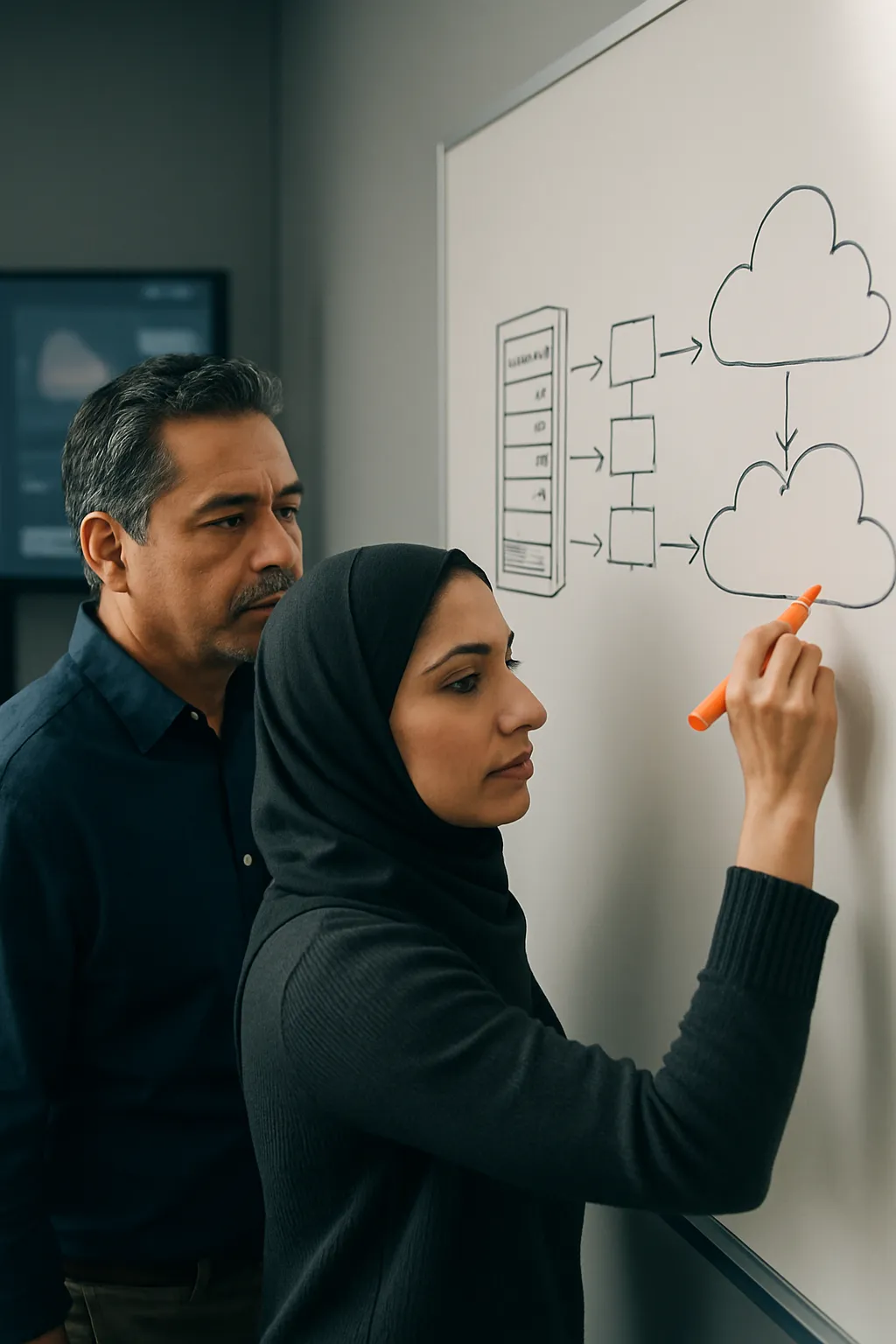
Modernise Your Infrastructure
Cloud Migration & Infrastructure Modernisation
Cloud migration requires more than moving servers; successful modernisation begins by understanding workloads, dependencies, data, operational requirements, risks, and the desired future environment.
Infrastructure and Application Discovery
Inventory servers, workloads, dependencies, storage, integrations, operating requirements, and infrastructure relationships before determining appropriate migration priorities and approaches.
Migration Readiness
Assess compatibility, data sensitivity, network dependencies, licensing considerations, operational constraints, and business-critical systems before selecting migration strategies.
Migration Strategy
Choose rehosting, replatforming, refactoring, retaining, or retiring approaches according to workload characteristics, modernisation objectives, dependencies, and business requirements.
Data Migration and Validation
Plan secure data movement, integrity checks, testing, reconciliation, and validation activities to establish confidence before workloads transition into their target environment.
Cutover and Rollback Planning
Define migration windows, acceptance criteria, rollback procedures, responsibilities, dependencies, and decision points before production workloads move into the new environment.
Post-Migration Optimisation
Validate performance, strengthen security, remove unnecessary resources, and review actual operating costs after migration to establish a manageable and optimised environment.
Structured migration planning helps reduce avoidable disruption, preserve critical dependencies, and create cloud environments that remain manageable and optimisable after cutover.
Optimise Cloud Spending
Cloud Cost Optimisation & FinOps
Effective cloud cost management requires visibility into spending and utilisation, followed by practical engineering decisions that balance financial efficiency with performance and reliability.
Cloud cost optimisation should balance spending with performance, reliability, security, and business priorities rather than pursuing reductions that create operational risk.
Cloud Spend Assessment
Review billing data, resource utilisation, cost allocation, and spending trends to understand where cloud expenditure originates and how it changes over time.
Resource Rightsizing
Match compute, memory, storage, and database capacity with observed workload requirements to reduce inefficient allocation while preserving appropriate application performance.
Idle Resource Management
Identify unused instances, unattached storage, outdated environments, and unnecessary services that continue consuming cloud resources without delivering meaningful workload value.
Autoscaling and Scheduling
Align infrastructure capacity with demand and schedule non-production resources to shut down when they are not required, improving utilisation without restricting necessary availability.
Cloud Pricing Optimisation
Evaluate reserved capacity, committed-use discounts, and suitable purchasing models against actual workload stability before changing cloud consumption strategies.
Storage and Data Transfer Costs
Review storage tiers, retention policies, network egress, and cross-region movement to identify infrastructure choices that unnecessarily increase recurring cloud expenditure.
Cost Allocation and Governance
Budgets, alerts, resource tagging, ownership, and regular cost reviews improve accountability while giving teams clearer visibility into infrastructure spending patterns.
Security by Design
Cloud Security, Governance & Compliance
Infrastructure security should be designed into cloud environments from the beginning, combining access controls, network protection, data safeguards, governance, and operational visibility.
Identity and Access Management
Least-privilege permissions, role-based access, and controlled administrative access help restrict infrastructure capabilities according to responsibilities, risks, and organisational requirements.
Network Security
Private networks, segmentation, security groups, firewalls, and secure connectivity help control infrastructure communication pathways and reduce unnecessary exposure.
Data Protection
Encryption, secrets management, backup controls, and appropriate key-management practices help protect sensitive information across infrastructure and operational environments.
Infrastructure Hardening
Secure configurations, patching practices, vulnerability management, and configuration baselines establish stronger infrastructure foundations and reduce avoidable security weaknesses.

Infrastructure-as-Code Security
Reviewing templates and configuration changes for policy violations and misconfigurations helps identify infrastructure risks before changes reach deployed environments.
Logging and Auditability
Centralised logging, security-event monitoring, and maintained audit trails provide greater visibility into infrastructure activity, operational events, and security-relevant changes.
Governance and Compliance Support
Infrastructure controls can be mapped against organisational policies and applicable regulatory requirements, with responsibilities, evidence, and operational expectations clearly defined.
Security and governance belong within infrastructure design, provisioning, deployment, and ongoing operations rather than being added after environments become operational.
Built for Resilience
High Availability, Disaster Recovery & Business Continuity
Resilient infrastructure prepares business-critical workloads for component failures, outages, and disruptive incidents while distinguishing prevention strategies from recovery capabilities.

High-Availability Architecture
Redundancy, health checks, load balancing, and failure isolation can reduce single points of failure and improve infrastructure resilience for critical workloads.
Multi-Zone and Multi-Region Design
Distributing workloads across zones or regions can support availability targets when justified by application requirements, latency considerations, risk tolerance, and operational complexity.
Backup and Recovery Planning
Backup frequency, retention, restoration procedures, and protection against accidental deletion or corruption should reflect workload importance and recovery requirements.
Recovery Time Objective (RTO)
RTO defines the acceptable time required to restore a service following an incident, providing a measurable recovery target for business-critical workloads.
Recovery Point Objective (RPO)
RPO defines acceptable data loss measured in time, helping organisations determine backup frequency and data-recovery expectations for individual workloads.
Disaster Recovery Testing
Planned restoration tests, failover exercises, and documented responsibilities help validate whether recovery procedures can work as intended during disruptive infrastructure events.
Business Continuity Planning
Infrastructure recovery arrangements should align with application dependencies, operational priorities, business-critical processes, and the organisation’s broader continuity requirements.
Infrastructure resilience planning helps organisations prepare for outages, restore critical workloads more predictably, and make recovery decisions around documented business requirements.
Our Approach
Our Cloud Infrastructure Engineering Process
Our structured delivery framework takes infrastructure from assessment through implementation and production operations, with repeatability, risk management, documentation, and operational readiness throughout.
Infrastructure Discovery & Assessment
Review infrastructure, workloads, dependencies, cloud spending, security controls, performance requirements, and business continuity objectives before defining the engineering approach.
Architecture & Implementation Planning
Define target architecture, platform selection, networking, identity controls, migration approach, automation requirements, dependencies, and measurable acceptance criteria.
Infrastructure Provisioning & Configuration
Build required environments using repeatable provisioning, Infrastructure-as-Code, standardised configurations, appropriate security controls, and documented implementation practices.
Validation, Security & Deployment
Test connectivity, performance, resilience, access controls, recovery procedures, and infrastructure configurations before production handover or workload cutover.
Monitoring, Optimisation & Operations
Establish monitoring and alerting, review utilisation and costs, address operational issues, and optimise environments as workloads and business requirements evolve.
The exact phases and deliverables depend on whether the engagement involves new infrastructure, migration, optimisation, modernisation, or ongoing management.
Industry Expertise
Cloud Infrastructure Solutions by Industry
Different industries bring different workload, security, availability, integration, and operational requirements, making infrastructure architecture dependent on the realities of each business environment.

Finance & FinTech
Financial platforms can support banking, transaction processing, analytics, and customer applications through secure networking, strong identity controls, audit logging, resilience, and governance.

Healthcare
Healthcare environments can support electronic health records, telehealth, and scheduling through protected data, controlled access, reliable connectivity, backups, and appropriate infrastructure configurations.

Retail & eCommerce
Retail infrastructure can support storefronts, inventory systems, customer applications, and seasonal demand through elastic capacity, load balancing, monitoring, and dependable data services.

Manufacturing
Manufacturing environments can support production systems, operational analytics, and connected equipment through dependable infrastructure, secure integration, workload isolation, and suitable hybrid connectivity.

Logistics & Transportation
Logistics infrastructure can support tracking, fleet applications, routing, and shipment visibility through scalable hosting, reliable APIs, data availability, and monitoring across distributed operations.

Education
Education platforms can support learning systems, student portals, digital classrooms, and analytics through scalable hosting, secure identity, backups, and capacity planning.

Real Estate
Real estate platforms can support property portals, CRM systems, virtual tours, and transaction services through reliable hosting, secure document storage, controlled access, and scalable infrastructure.

Aviation
Aviation environments can support scheduling, maintenance, operational tracking, and business applications through planned availability, controlled access, resilient integrations, and appropriate infrastructure arrangements.
What Sets Our Approach Apart
Why Choose Wildnet Edge for Cloud Infrastructure Services
Wildnet Edge approaches cloud infrastructure as an engineering discipline, combining architecture, automation, security, optimisation, resilience, and operational support around documented business requirements.

Business-Aligned Cloud Architecture
Architecture decisions account for business priorities, workload behaviour, security needs, availability targets, and operating costs rather than focusing solely on technology selection.

Multi-Platform Cloud Engineering
AWS, Azure, Google Cloud, and hybrid environments can be evaluated according to documented requirements instead of forcing every workload onto one platform.

Infrastructure-as-Code & Automation
Version-controlled infrastructure definitions, repeatable deployments, and automated configuration reduce manual effort while helping maintain consistency across cloud environments.

Security-First Infrastructure Design
Access controls, network protection, encryption, monitoring, and governance requirements can be incorporated into infrastructure from initial design through ongoing operations.

Cost & Performance Optimisation
Resource utilisation reviews, capacity planning, cost visibility, and workload-specific optimisation help balance infrastructure efficiency with reliability, security, and performance requirements.

Resilience & Disaster Recovery Planning
Recovery objectives, redundancy, backup validation, and failover planning can be tailored according to the importance and operational requirements of individual workloads.

Ongoing Cloud Operations & Support
Monitoring, patching, incident handling, and periodic optimisation help maintain infrastructure health after deployment under an agreed operational support model.
Engagement Models
Cloud Infrastructure Engagement Models
Different infrastructure requirements call for different engagement structures, depending on project scope, engineering workload, internal capabilities, and ongoing operational responsibilities.

Fixed-Scope Cloud Infrastructure Project
Suitable for defined deliverables such as new environments, automation, security hardening, or targeted optimisation, with agreed scope, dependencies, acceptance criteria, responsibilities, and handover requirements.
Dedicated Cloud Engineering Team
Suitable for continuing infrastructure work, multiple environments, or evolving backlogs requiring support across provisioning, automation, architecture implementation, reliability improvements, and internal engineering collaboration.
Cloud Migration & Modernisation Engagement
Suitable for organisations moving from on-premises infrastructure or modernising cloud environments through workload discovery, dependency mapping, migration waves, testing, cutover, and post-migration validation.
Managed Cloud Infrastructure Services
Suitable for ongoing operational support covering monitoring, maintenance, incident escalation, reporting, optimisation reviews, and service expectations defined according to the agreed support model.
In Their Words
Rated 4.89 across 104 reviews
Quotes are from engineering and product leaders, the people who own the outcome.

“Partnering with Wildnet Edge was a game-changer for our department. Their deep understanding of government processes, combined with cutting-edge AI capabilities, helped us modernize outdated systems with minimal disruption. The result? A faster, smarter, and more transparent public service delivery model.”

“Wildnet Edge truly exceeded our expectations. Their AI-first approach helped us streamline product development and automate key workflows, allowing our team to focus on innovation. Their proactive collaboration and agile execution felt like having a tech co-founder on our side.”

“Working with Wildnet Edge was transformative. They brought deep expertise in AI, cloud, and agile delivery that enabled us to modernize legacy systems without disruption. Their ability to deliver complex solutions at scale made them an essential partner in our digital evolution.”
Straight answers
The questions you were going to ask on the call.
Clear expectations make better partnerships. Here is where the conversation starts.
What are cloud infrastructure services?
Cloud infrastructure services cover cloud design, provisioning, configuration, security, optimisation, and management across compute, storage, networking, and operational controls.
Which cloud platforms does Wildnet Edge support?
Wildnet Edge supports AWS, Microsoft Azure, Google Cloud, and suitable hybrid or multi-cloud environments according to workload, security, operational, and cost requirements.
How much do cloud infrastructure services cost?
Pricing depends on infrastructure complexity, workload volume, migration scope, security requirements, automation needs, provider charges, and ongoing support expectations.
Can you migrate our existing infrastructure to the cloud?
Yes, migration can include discovery, dependency mapping, planning, data transfer, testing, cutover, rollback planning, and post-migration optimisation based on workload requirements.
How do you optimise cloud infrastructure costs?
Cost optimisation can involve rightsizing, utilisation analysis, idle-resource management, autoscaling, storage optimisation, pricing reviews, and ongoing spending monitoring.
How do you secure cloud infrastructure?
Security can include IAM, least-privilege access, network controls, encryption, secrets management, patching, audit logging, and configuration monitoring.
Can you support hybrid cloud and multi-cloud environments?
Yes, support can cover secure connectivity, workload placement, governance, monitoring, and operational controls while recognising the additional complexity multi-cloud environments introduce.
Do you provide ongoing cloud infrastructure management?
Ongoing management can include monitoring, patching, incident response, log analysis, capacity planning, security reviews, and cost optimisation under an agreed support scope.
Contact Us
Let’s Build for Outcome
Let’s co-create solutions that deliver measurable impact.
Get started
The Technology Edge Your Business Deserves.
A working session, not a pitch. 30 minutes session on solving your problem.
Prefer to just pick a time? Book a 30-minute roadmap call